How to build your first modeling portfolio on a budget starts with smart choices, strong basics, and photos that sell your look—not a fantasy.
The first modeling portfolio has a strange place in fashion mythology. New models are often told it must look expensive, glossy, and vaguely European, as if a leather-bound book and a rented loft in Brooklyn are the minimum ticket to entry. They are not. A beginner portfolio is not meant to prove that you can spend money. It is meant to show that a camera can understand your face, your proportions, your presence, and your range.
That is the useful truth under all the noise: agencies and scouts are not looking for a finished fantasy. They are looking for evidence. Can you photograph well? Do you have clean features, movement, focus, and versatility? Can you take direction? A strong starter portfolio answers those questions with clarity. A weak one tries to distract from them with costumes, heavy retouching, and enough fake drama to power a weekday soap opera.
If you are trying to build your first modeling portfolio on a budget, the good news is that restraint is not a compromise. In many cases, it is the point. Simplicity reads as confidence. It also saves money, which is useful when your bank account is behaving like a minimalist installation.
Start With What Agencies Actually Need
The most budget-friendly decision is also the most strategic: build only what is necessary. A first portfolio does not need twenty elaborate images. It needs a tight edit of strong, honest photographs. Think clean headshots, natural light, a simple full-length image, and a few fashion-oriented shots that show different sides of your look without making you unrecognizable from one frame to the next.
Before arranging any shoot, spend time studying agency websites. Look at the digitals and starter books of newer models, not just the biggest names. You will notice a pattern. The strongest beginner images are usually simple. Neutral styling. Clear skin texture. Minimal makeup. Good posture. Real expressions. The industry calls this “clean” because that is exactly what it is: information without clutter.
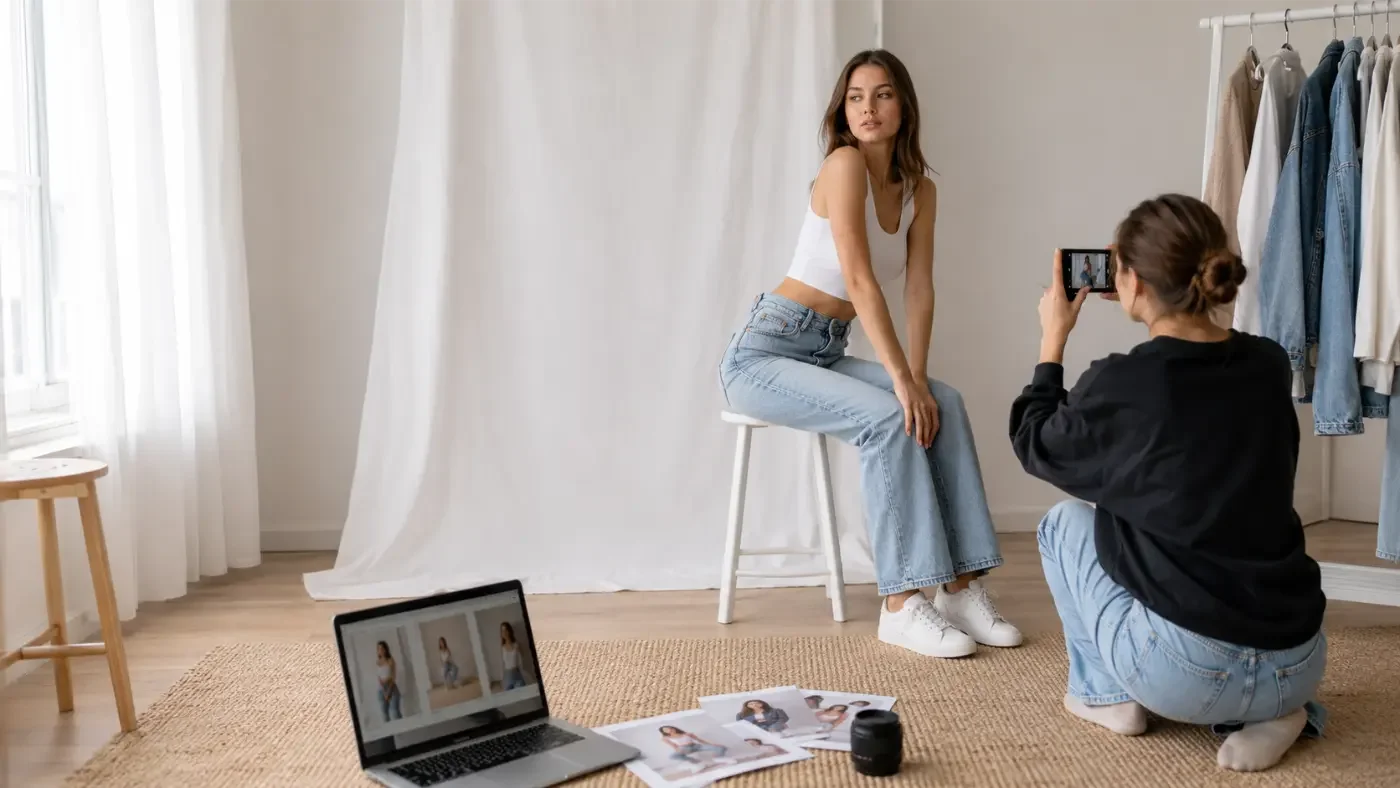
If you have no budget at all, begin with digitals. These are plain, well-lit images taken in fitted clothing against a simple background. Front, profile, three-quarter, smiling, unsmiling, and full length. No heavy filters, no dramatic poses, no nightclub lighting that makes you look like a witness protection reveal. Digitals are useful because they tell a scout what you actually look like. That is valuable. Sometimes more valuable than a “creative” image trying much too hard.
When you are ready for a proper test shoot, work with emerging photographers, makeup artists, and stylists who are also building their books. The fashion economy runs, in part, on this mutual hustle. The trick is to be selective. “Free” is not a bargain if the images are unusable. Look for collaborators with clean technical skill, a steady eye, and a portfolio that shows they understand faces, not just presets. If they turn every subject into the same moody blur, move along.
On a budget, one well-planned test shoot is better than three chaotic ones. Choose a photographer who can give you variety in a short session. A studio is nice, but not essential. A large window, a quiet street, a blank wall, and thoughtful direction can produce excellent results. Fashion has always loved the myth of effortless glamour. In reality, good light does most of the heavy lifting.
Style Smart, Not Expensive
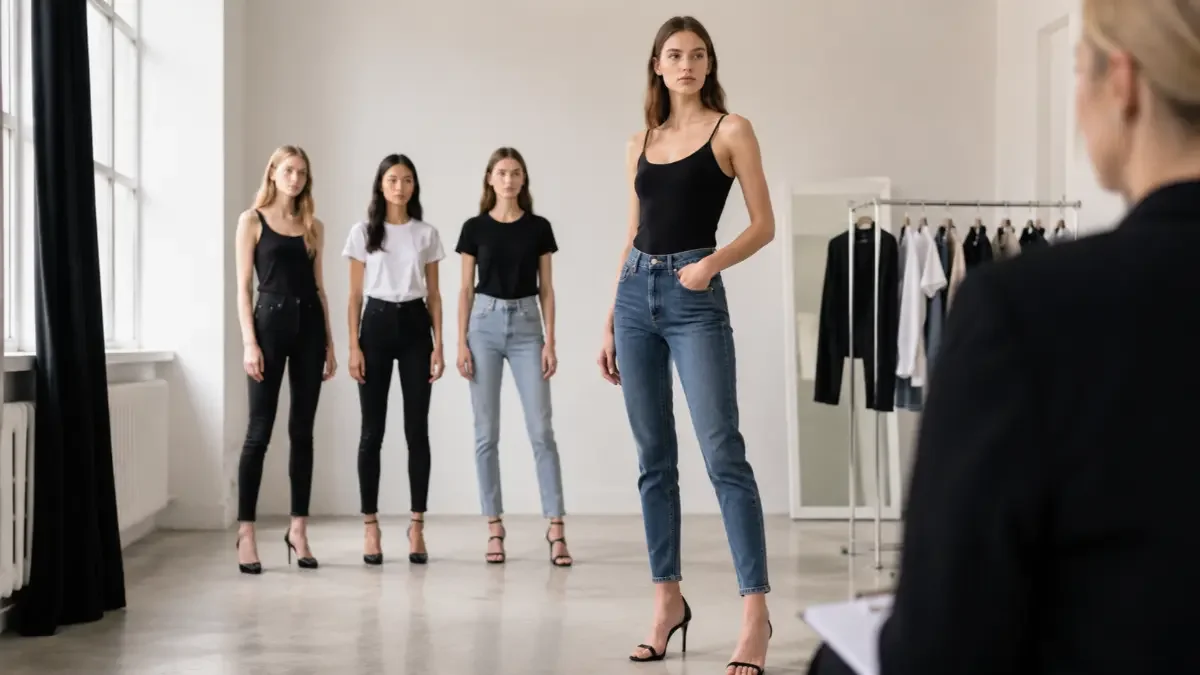
Clothes in a first portfolio should frame the model, not compete with them. This is where beginners often waste money. They imagine they need trend-heavy looks, borrowed designer pieces, or a suitcase of outfit changes. Usually they need the opposite. Start with basics that fit extremely well: a plain white tee, a black tank, straight jeans, a simple slip dress, tailored trousers, a clean blazer, classic heels, and minimal jewelry. The keyword is fit. Affordable clothes that fit beautifully will photograph better than expensive clothes that pull, sag, or swallow your shape whole.
Hair and makeup should also serve the same logic. Keep one look very natural. If you add a second beauty direction, make sure it still looks like you on your best day, not you after a full identity overhaul. Agencies want continuity between your portfolio, your digitals, and the person who walks through the door. Surprise is a fine quality in art, less so in casting.
Posing matters, but it is often misunderstood. A beginner portfolio does not need acrobatics. It needs awareness. Learn how your face changes with tiny shifts of angle. Practice your posture. Study your hands. Understand where tension collects in your jaw, shoulders, and mouth. The camera notices everything. That sounds cruel, but it is also liberating. Once you know what it sees, you can work with it instead of fighting it.
It helps to think of modeling not as “looking pretty,” but as communicating clearly through your body. That is why a simple image can be so persuasive. It leaves nowhere to hide, and nowhere to get lost.
Edit Ruthlessly and Keep It Honest
After the shoot, the real budget skill is editing. New models often believe more photos mean more chances. Usually, more photos mean more filler. A first portfolio should feel concise and intentional. Eight to twelve strong images can do far more than twenty mediocre ones. Choose the shots that reveal something specific: your bone structure, your height, your silhouette, your ease in front of the camera, your ability to shift mood without becoming theatrical.
Avoid excessive retouching. Skin is allowed to look like skin. Texture is not a scandal. If every image is polished into wax, you are not building trust; you are building confusion. Scouts and clients need to know what they are booking. In that sense, honesty is not just morally charming. It is marketable.
Presentation matters too, but here again, simplicity wins. A clean digital portfolio or comp card is enough to start. You do not need an extravagant printed book on day one. Save that money for transportation to castings, occasional test shoots, and the everyday maintenance that modeling quietly requires. The industry may sell fantasy, but careers are built on logistics.
If there is one principle that ties the whole process together, it is this: your first modeling portfolio should make you legible. Not overproduced, not disguised, not inflated into a version of yourself that cannot survive daylight. Just clear. In a business full of noise, clarity is power. And conveniently, it is also cheap.
“Simplicity is the keynote of all true elegance.”
Coco Chanel said that, and whatever one thinks of fashion’s many grand declarations, this one survives because it keeps proving itself. Your first book does not need to shout. It needs to introduce you. If it does that well, it is already doing the hardest job in the room.